

What is PRP for hair?
PRP (Platelet Rich Plasma) treatment against hair loss and enhancing Hair Transplantation is a supportive method of treating hair loss and regeneration < 0 > in men and women.
Prevention
- Applying PRP in the initial stages of thinning prevents loss.
- It has also been used to strengthen the new hair follicles that will be placed in the recipient area, increasing the effectiveness of the result.
Review
- Androgenetic alopecia (AGA) is a hair loss disorder that affects 80% of men and 50% of women during their lifetime. Treatments for AGA are limited and there is no cure.
- Platelet-rich plasma (PRP), a treatment modality that appears to promote ulcer healing, has also been studied as a treatment for AGA.
- This review was conducted to evaluate the effectiveness of PRP treatment for AGA. It includes twelve studies conducted from 2011 to 2017.
- A total of 295 individuals underwent PRP or control treatment and were evaluated for hair density, hair quality, and anagen/telogen hair ratio.
- Most of the studies reviewed showed the effectiveness of PRP in increasing the diameter and density of telogen hairs.
Platelet-rich plasma (PRP) contains various growth factors and cytokines that enhance the body’s inherent ability to repair and regenerate.
- PRP has traditionally been used in periodontal therapy, maxillofacial surgery, orthopedics, and by sports medicine physicians.
- More recently, it has attracted interest in the field of dermatology, particularly for its role in the treatment of acne scars, fat grafting, facial reconstruction, ulcer healing, and hair regeneration.
The principle behind PRP therapy is to enrich platelets through centrifugation and have the beneficial effects of PRP. Such as the proliferation of adipose precursor cells, better wound healing, cellular differentiation and angiogenesis.
- Among the cells in a typical blood sample, 93% are red blood cells (RBCs), 6% platelets, and 1% white blood cells.
- A platelet concentration 5 times the normal concentration has proven its effectiveness in tissue repair and its strong anti-inflammatory effect.
- Our platelets are known for their hemostatic functions.
- However, they also contain a vast reservoir of over 800 proteins which, when secreted, act on many targets including stem cells, fibroblasts, osteoblasts, endothelial and epithelial cells.
- There are other active ingredients within PRP, most notably fibrinogen and leukocytes. And the thinking is that the therapeutic benefits of PRP come not just from the platelets but from the combination of complex and growth factors.
Some patient parameters such as hydration status, infection, lipemia, and hematocrit play a role in the final PRP characteristics.
In 2012, a classification system for PRP was created based on the number of leukocytes and their architecture.
- Pure PRP, leukocyte-rich plasma and platelets (L-PRP).
- Clear in plasma and rich in fibrin and leukocytes.
- And platelets rich in fibrin.
Despite variations, all protocols for PRP preparation follow a general sequence.
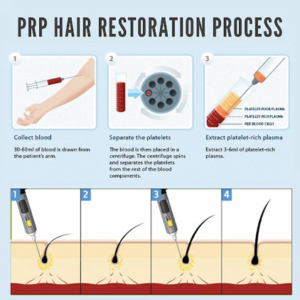
PRP and hair regeneration
PRP contains a high concentration of factors such as
- platelet-derived growth factor
- vascular endothelial growth factor
- the VEGF factor
- epidermal growth factor
- fibroblast growth factor
- insulin-like growth factor IGF-1
The growth factors in PRP promote hair regeneration by binding to the corresponding receptors expressed by the stem cells of the hair BULGE area and related tissues.
The activated autologous PRP has also been observed to stimulate the proliferation of skin cells by modulating the fibroblast growth factor-7 and β-catenin 1, key proteins that regulate cell migration, adhesion, proliferation, and differentiation.
After reviewing 76 articles, 64 were excluded, and 12 studies were evaluated, which were deemed complete and relevant.
Positive results and 4 new studies
1. A recent pilot study by ATITUA ET AL. evaluated the use of growth factor-rich plasma in 19 individuals with AGA.
The patients were given 5 injections (PRGF) to release growth factors. Compared to the initial assessment, all patients showed positive results after one year of follow-up.
The effectiveness of PRP for Androgenetic Alopecia showed statistically significant improvement in:
- Average hair density.
- Average hair diameter.
- Percentage of telogen hairs.
- Histomorphometric evaluation advocated the use of PRP, showing improvement in epidermal thickness, perifollicular neoangiogenesis, and telogen hair ratio as well as reduced perivascular inflammatory infiltrates.
- Overall, patients were satisfied with their clinical improvement.
2. Alves and Grimalt conducted a study with 25 patients in a blinded randomized study, among whom 22 completed the trial.
The subjects were divided into 2 groups:
- Group A, which received 3 ml of PRP on the right half of the head and 3 ml of saline placebo on the left.
- And group B, which received the same 2 solutions on opposite sides of the head.
- After 3 and 6 months, there were statistically significant improvements detected in anagen hair, telogen hair, hair density, and final hair density in PRP-treated areas compared to baseline (p<0.05).
- Η μέση ολική πυκνότητα μαλλιών ήταν το μόνο μέτρο που βρέθηκε ότι ήταν σημαντικά αυξημένο με PRP έναντι εικονικών περιοχών (p<0,05 ).
3. The Gentiles et al. evaluated the results of PRP treatment in 20 patients.
- PRP was injected into half of each patient’s affected scalp, while the other side received normal saline.
- The study found a statistically significant increase in all outcomes, including average hair count, hair texture, and hair density after 3 months of PRP treatment compared to placebo.
- Immunohistochemistry was performed and the percentage of Ki67+ cells increased in both the epidermis and the hair follicle bulge at 2 weeks after PRP treatment.
- The researchers also observed an increase in the number of small blood vessels around the hair follicles (p<0.05 at 2 weeks after PRP compared to baseline), supporting the view that PRP promotes angiogenesis through the release of vascular growth factors.
4. Gupta et al. enrolled 30 men.
Each participant received 6 PRP massage treatments after the scalp was first activated with microneedling. After 6 months of follow-up, Trichoscan vertex assessment (10 cm from the forehead) showed a significant increase in hair diameter and density.
The evaluation of photos from around the world by a random observer showed an average improvement of 30.2 ± 12.2 %.
- Self-assessment questionnaires also revealed improvement with PRP treatment, more significant in those with lesser degrees of alopecia, in terms of hair diameter (p=0.0446) and density (p=0.0196).
- Efficacy was more pronounced in individuals with more recent disease onset before treatment and in individuals without a family history of alopecia, with improvements in hair diameter (p=0.0485 and p=0.0272 respectively) and hair density (p=0.0096 and p=0.0114 respectively).
Studies with negative results
Two studies did not show a statistically significant improvement in the evaluated outcomes.
1. Puig et al. conducted a double-blind, randomized, placebo-controlled, multicenter trial involving 26 women with female pattern hair loss. Fifteen women were randomized to the PRP group and eleven to the placebo group. The researchers marked a 4 cm² area on the central scalp, where the hair was repeatedly analyzed for hair mass throughout the study using the HairCheck device.
- They received an injection of PRP or saline 4 cm from this area at week 0. At week 26, no statistically significant difference was found between the treatment and control groups in terms of hair count and hair mass index.
- People who received PRP, however, reported subjective improvement in hair loss, hair loss rate, hair thickness, and ease of hair styling, which none of the people who received a placebo showed.
2. The second study was a pilot comparative study conducted by Mapar et al. involving 17 men with androgenetic alopecia (AGA). The researchers administered PRP or normal saline over two sessions within one month. The results showed an average increase in the number of terminal and vellus hairs after 6 months of PRP treatment, as evaluated using a magnifying lens.
Consequently, the researchers found no statistically significant difference in the outcomes observed between baseline treatment.
Suggested Treatment Protocol
Current protocols for the preparation and administration of PRP vary widely. After careful evaluation of published studies, we have the following recommendations for the use of PRP as a treatment for AGA.
- We propose protocols for PRP preparation that include a double-spin centrifugation method, consisting of a first spin at 1,500 -1,700 RPM for 6-10 minutes followed by a second spin at 2,500 rpm. for 10-15 minutes. Other studies, however, used a rotation method (ranging from 460 to 1,500 G /580 RPM for 5-8 minutes) and also reported beneficial results.
- The use of an activator, preferably a compound containing calcium, such as calcium chloride or calcium gluconate, would activate platelets to release growth factors and cytokines and would likely provide better results.
- The amount of total PRP injected varied widely between the studies reviewed, making it difficult to express the volume necessary for optimal results.
- Based on studies with positive results, a mean volume of 6.2 ml (range 3-12 ml) of pure PRP with an average platelet enrichment of 3-6 x should be injected.
- Intradermal injections should be made at approximately 0.1 ml/cm2 in selected areas of the scalp using the Nappage technique (multiple small injections in a linear pattern of 1 cm diameter at a depth of 1.5-2.5 mm).
- Anesthesia is not required. However, we recommend it based on reports of pain during the procedure.
- At least 3 sessions over a 1-month period are recommended, although 2- and 3-week intervals were also a common regimen that yielded positive results.
In this literature review we evaluated the effectiveness of PRP treatment in AGA in 12 studies and concluded that PRP was effective in hair growth.
- Ten of the 12 studies saw positive results in the therapeutic ability of PRP for the treatment of AGA.
- Among these, 6 studies demonstrated statistically significant improvement after PRP treatment using objective measures and 4 additional studies showed improvement in hair (hair density, diameter) with PRP although no p values were described or statistical analysis was performed.
- Only one study, by Mapar et al., concluded that PRP was not effective in treating AGA by analyzing hair and follicle counts. However, the results were evaluated under a magnifying glass.
Contraindications
Contraindications of treatment with autologous PRP material are:
- Cases of skin cancer (basal cell or squamous cell carcinoma, melanoma)
- In chemotherapy
- Σε αιματολογικά νοσήματα (θρομβοκυττοπενία, υποινωδογονεμία κ.ά.)
- In platelet dysfunction
- On anticoagulant therapy
- In hemodynamic instability
- In local skin infection or sepsis
- In chronic liver diseases
- In hepatitis
- In severe autoimmune diseases (such as multiple sclerosis, lupus, dermatomyositis)
- In alopecia areata
- If you are allergic to local anesthetic
- During pregnancy and lactation
What is PRP for the face?
PRP therapy is a skin rejuvenation method that uses the extremely useful growth factors contained in plateletsof the blood. Platelets have the property, under certain conditions, to release proteins (growth factors) that are associated with skin healing and regeneration.
It is the ideal anti-aging technique that helps maintain healthy and glowing skin by preventing damage caused by the effects of time and the environment.
Specifically:
- Causes better vascularization and oxygenation of the area due to newly formed capillaries
- Promotes the production of collagen and elastin
- Increases cell metabolism
- Improves lines and fine wrinkles on the face/neck/décolleté
- Causes very active hydration
- Corrects dark circles under the eyes
- Improves overall skin texture and tone
- Helps with certain types of alopecia or general hair thinning
- Provides increased skin radiance
- Reduces hyperpigmentation
- Treats skin sagging throughout the body
- Offers faster healing after aesthetic treatments, e.g. laser skin treatment and microneedling
Application areas are the face, neck, décolleté, hands or in areas where there is body relaxation.
Contraindications
- Blood clotting disorders
- Pregnancy
- History of thrombosis
- AIDS
- Presence of malignancy
- Chronic liver disease
Summary – Conclusions
The result of PRP treatment is healthier skin with radiance, fewer wrinkles, well-hydrated without sagging,
as well as thicker, healthier hair. PRP therapy can be applied to the face, neck, décolleté, hands, scalp, and any other area of the body that requires regeneration.
The advantages of treatment with Autologous Growth Factors (PRP) compared to other well-known therapies (hyaluronic acid, BOTOX, vitamins, etc.) are that it uses exclusively autologous factors, meaning derived from your own body.