


The trichogram is a non-invasive diagnostic method used to determine the type of alopecia. It helps observe the morphology of the hair and gives the doctor a general overview of the scalp’s condition. It is a safe method that provides accurate results for managing the specific condition. Additionally, it can detect other hair disorders or abnormalities and helps monitor the progression of the disease. The trichogram shows us the hair density and categorizes it. Normally, we lose up to 100 hairs per day.
More specifically, the factors that contribute, among others, to pathological hair loss are:
- The stress
- Invasive hair techniques
- Seasonality (e.g. autumn)
- A diet poor in nutrients
- Anemia
- Hormonal changes (e.g. postpartum, menopause)
- Thyroid disorders
- Heredity
Visiting a doctor to make a diagnosis and find the causes of hair loss is crucial for the progress of treatment.
The trichorhizogram is one of the most important tests that can provide answers to the problem of hair loss.
Essentially, we record the percentages of normal and pathological hairs and determine whether the hair growth cycle follows its natural course. What matters most is the regeneration of the hairs, the number of hairs that fall out, and the number of diseased or dystrophic hairs — that is, hairs that are thinner and have a shorter lifespan than normal.
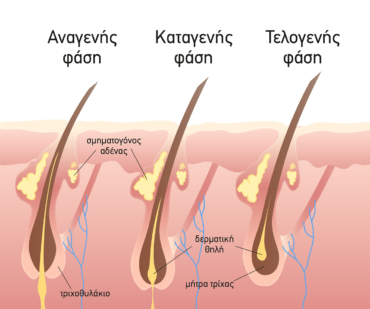
More specifically, hair is divided into anagen, catagen, telogen and dystrophic phases.
The trichorhizogram examination is simple and direct.
With the help of a special medical tool, the “needle holder”, the dermatologist extracts approximately 50 hairs from the scalp.
He then examines them under a microscope to determine which ones are healthy and which ones are pathological and whether hair regeneration is following a normal rhythm.
In a trichorhizogram, hairs are collected from different parts of the scalp so that the sample is complete and representative.
Normally, 50-100 hairs fall out per day and in a trichorizogram we expect 70% of the hairs to be in the anagen phase (the hair growth phase), <2% in the catagen phase (the transitional stage before hair falls out), < 20% in the telogen phase (resting phase until the hair falls out) and only up to 5% can be characterized as dystrophic hair.
A necessary condition for a correct trichorhizogram is that we have not washed our hair for 3-5 days.
A large deviation means a severe problem, while a small deviation means a mild problem, as usually occurs in seasonal hair loss problems or after childbirth. Any deviation from normal values is evaluated accordingly, with the administration of appropriate treatment.
In conclusion, a trichogram can reveal the cause of hair loss and guide us toward the appropriate treatment, whether through hair transplantation or in combination with topical therapy. At the specialized LP CLINIC, the procedure can be performed quickly and painlessly by a dermatologist, and, depending on the case, a personalized treatment plan can be created to address the problem.